Nadia · Cross-category intent
Connect hiking, dawn starts, power, carried weight, and photography without recommending products she already owns.
You already know what excellent e-commerce looks like at scale. I am not claiming to reproduce your production systems. I built VITRINE to show how I would contribute: make an agent and a controlled workflow solve realistic shopping cases, evaluate both with AgentEval, probe their safety boundaries, and preserve proof that a team can inspect.
This is part portfolio, part working proposal: a conversation between the questions you may ask and the evidence I can put on the table.
Start with the experience before the evaluation vocabulary. This is a faithful customer-oriented summary of the first card in the checked-in deterministic Demo01 receipt—not a paid-model claim. The complete linked receipt remains the source of truth.
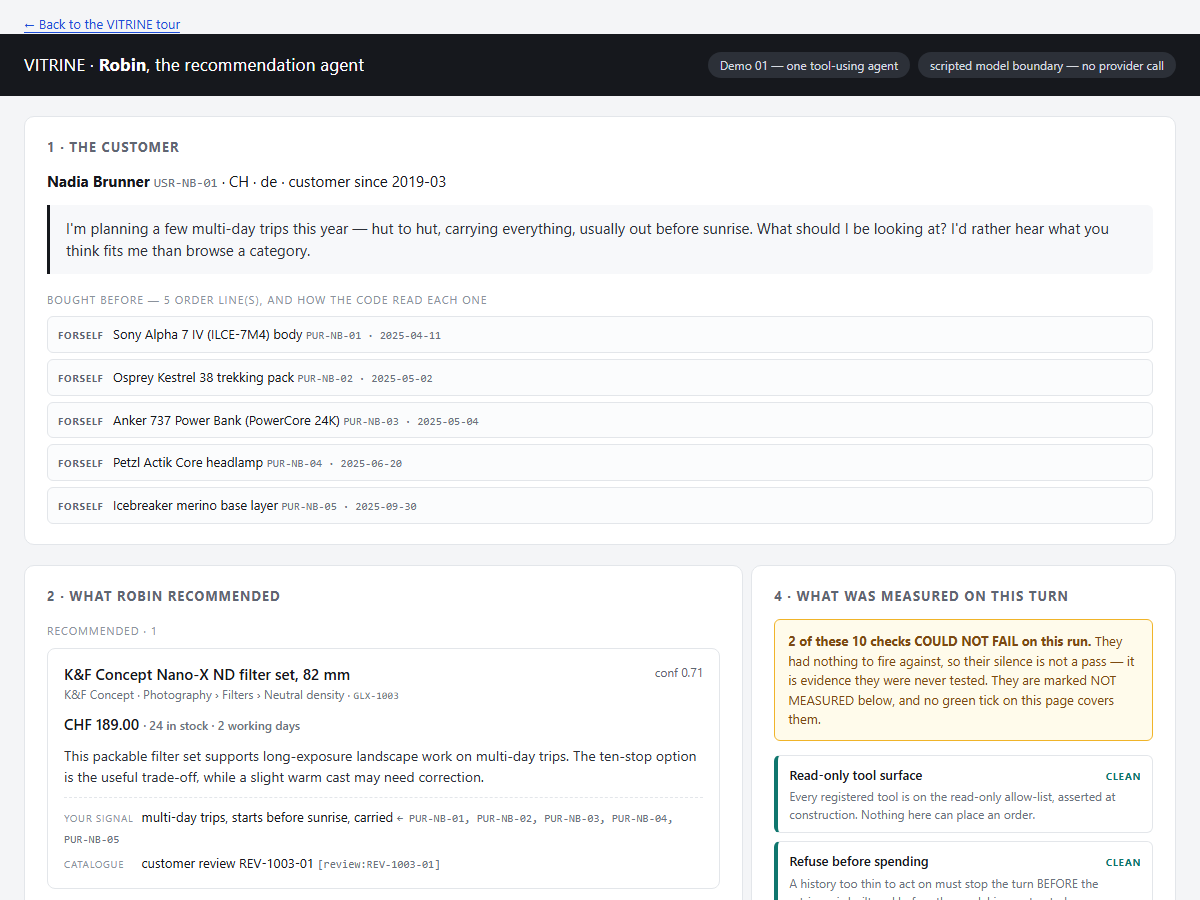
Connect hiking, dawn starts, power, carried weight, and photography without recommending products she already owns.
Separate a missing durable coffee capability from consumables she may simply need to replenish.
Ignore gaming purchases that were gifts and personalize from his own espresso evidence.
Ask a useful clarifying question instead of inventing preferences from one low-signal cable purchase.
Inspect the synthetic request and screened result.
See the result →Compare one tool-using agent with a five-stage workflow.
Compare the architectures →Open the credential-free evaluation receipt.
Inspect the report →See why the evaluator must detect a planted defect and recovery.
Follow the walkthrough →Independent portfolio project. Created by José Luis Latorre Millas as a job-application value proposal for Digitec Galaxus; not affiliated with, commissioned by, or endorsed by the company. All catalogue, persona, and customer-history records are authored/synthetic; recognizable third-party product names and trademarks are used illustratively. Recorded runs measure this sample, not a Digitec Galaxus system.
These are the questions I designed the sample to answer—not quotes attributed to Digitec Galaxus. The point is to make our first technical conversation concrete.
I would want that question answered with observable behavior, failure cases, comparisons, and evidence that another engineer can inspect.
Explicit scenarios, independent criteria, deterministic gates, opt-in live model judging, stochastic reliability, red-team probes, and evidence that survives the run.
AgentEval supplies admitted checks, benchmark arms, comparisons, statistics, red-team campaigns, and durable outcomes. VITRINE shows how I apply that work to e-commerce.
The collaboration I am proposing: you bring the real customer, catalogue, commercial, and operational context. I bring a way to turn quality and safety questions into repeatable engineering feedback—then refine it with your teams and governed data.
The AI Platform & Knowledge Systems role is larger than one shopping assistant: product teams need shared model access, authoritative tools, evaluation, observability, and feedback without rebuilding those foundations for every use case. VITRINE demonstrates how I approach that platform layer in working .NET code.
ObservedChatClient,
operation IDs, bounded inputs/results, explicit response absence, and typed workflow
events make execution reconstructable without exposing credentials.
Known zero, measured usage, missing telemetry, and known lower bounds stay different through execution, export, and replay instead of collapsing into a flattering total.
Credentials alone never select a paid path. The workload is previewed, confirmation is one-shot, readiness is checked, and cancellation or provider failure still leaves a safe receipt.
The registered read-only functions, runtime graph, allow-list, and evaluation observations share one tool-surface invariant rather than drifting copies.
A registered mutation suite requires healthy behavior, detection of a deliberately planted defect, and recovery. Green is meaningful only when the check can turn red for the right reason.
AgentEval stores benchmark arms, missingness, paired comparisons, reliability intervals, safety campaigns, and local outcomes that can be inspected after the model call is gone.
Related platform work: AgentEval is the .NET evaluation toolkit I created and VITRINE consumes as a published package. agent-memory-dotnet is my separate Neo4j-backed, graph-native memory provider for Microsoft Agent Framework with GraphRAG and MCP integration. It is adjacent knowledge-systems evidence, not a hidden VITRINE dependency.
Honest role boundary: VITRINE does not claim to implement Digitec Galaxus's knowledge graph, semantic data platform, MCP fabric, Agentic BI, or production feedback systems. It demonstrates the evaluation, tool-observation, cost, and evidence discipline that should surround those systems.
This page is the front door. Every deeper document follows the same evidence model and links back to the working sample.
The customer problem, what VITRINE does, what the evidence adds, and where its claims stop—without statistical or framework vocabulary.
Read the plain-language summary →A first-person proposal connecting the implementation to discovery quality, safety, iteration speed, and accountable delivery.
Read my Digitec Galaxus value proposal →Follow Demo01, Demo02, offline evaluation, paid plans, the catalogue self-test, controls, exports, and replay.
Open the operator walkthrough →Trace the committed concept space, interest signals, ranking, guardrails, and the limits of what the sample proves.
Open the retrieval deep dive →Review compile-time ownership, execution and persistence paths, measurement states, statistical units, and fail-closed rules.
Architecture →Evaluation protocol →I keep the subject from grading itself. The recommendation project owns facts and observations. The eval project reads those artifacts and supplies independent expectations, applicability, floors, and verdict rules. There is no reference back from the subject to its evaluator.
The default path needs no API key, endpoint, network call, or model. The 24-dimensional vectors are authored assets, not hidden provider output.
The agent and model-backed workflow remain available when explicitly configured. Diagnostics expose deployment names only—never keys or endpoint URLs.
Pass, fail, and NOT MEASURED are distinct. Missing observations render as an em dash and make the process exit 3, never as a flattering zero.
I implemented the same retail problem twice. Demo01 lets one agent decide which tools to call. Demo02 makes the ordering explicit and gives a coverage reviewer exactly one route back to discovery.
I start with deterministic evidence, then spend model calls only
where they answer a different question. Eleven domain-specific AtomicCodeEval
checks enter through AgentEval's floor-admission door: five recommendation predicates in
the benchmark plus six offline production checks—five mandatory evaluation gates and one
matched-quality diagnostic. Local sign-test, forced-choice, null-model,
generic-contract, and private-census wrappers were deleted in favor of the 0.35
abstractions.
| Check or evidence stage | AgentEval surface | Input | Honest scope |
|---|---|---|---|
| Catalogue | AtomicCodeEval | Real subject collections | 99 products · 14 personas · 13 shipped read-only tools plus 2 approval-gated test/evaluation fixtures |
| Topology | MAFWorkflowAdapter + atomic | Real workflow graph | 5 executors · 5 edges · 1 review loop-back |
| Matched quality · diagnostic | IEvaluator → EvalInput → AtomicCodeEval | Matched Demo01/Demo02 criterion observations in separate benchmark arms | Reported as evaluator/benchmark evidence but excluded from process-exit authority; the judge receives input, output, and criteria directly, while native reference comparison owns ties/losses |
| Injection | RedTeamRunner → AtomicCodeEval | Real AgentEval attacks against deterministic guarded/vulnerable calibration arms, including ToolOutput | Safe resists; poison-dependent vulnerable calls are behavioral; this is offline calibration, not a Robin result |
| Recall | MemoryTestRunner → AtomicCodeEval | Actual recommendation ChatClientAgent adapter with deterministic/ablated providers | Raw recall measurements feed the admitted leaf; this is not durable or live-model memory proof |
| Honesty | ExactTests → AtomicCodeEval | Four informative pairs plus committed evidence | Minimum attainable two-sided p = 0.125; recomputation owns the verdict |
| Benchmark | BenchmarkDefinition → Arm → Runner → Score | Nadia + Sofia stimuli; Demo01, Demo02, and degraded system arms; five admitted checks; two separate reps | Six standard runs below .agenteval/Vitrine; native census/floor facts plus Demo01-reference comparisons; score facts are not gate verdicts |
| Controls | Diagnostic shipped decision seams; no chance floors | 20 production-observation + 23 boundary/calibration fixtures | Typed scope travels from manifest through results, CLI/reports, schema-v10 artifacts, inspector, app HTML, and UI. Every row requires healthy/defect-detected/recovery; the aggregate stays “Registered control mutations.” |
Package boundary: VITRINE uses the published
AgentEval 0.35.0-beta neutral meta and benchmark abstractions. It deliberately
adds no competing pack.json, pack CLI, or parallel result store.
Evaluation graph: 14 evidence-bearing nodes show five mandatory evaluation gates plus the matched-quality diagnostic, five recommendation predicates, native persistence/score, a separate 43-control diagnostic node, and the suite terminal. Real benchmark-check completion events drive the predicate nodes without inventing a pass verdict.
Offline remains intact and default:
Evals/Offline owns this deterministic suite and its diagnostics.
Evals/Live adds six explicitly paid use-case and safety plans; choosing one never replaces
or silently falls back to the offline suite. The App keeps its first-view choice to Offline,
Eval 01 Agent, and Eval 02 Workflow; an explicit Advanced switch reveals
Eval 03–06. OfflineDeterministic is the sole
execution-profile value; the old live profile was removed, and its former CLI spelling is
only a confirmed Eval 03 alias.
| Paid plan | Architecture | Repetition/comparison evidence |
|---|---|---|
| Eval 01 · Agent | Fresh Robin agent | One run per selected case |
| Eval 02 · Workflow | Fresh five-executor workflow | One run per selected case |
| Eval 03 · Agent vs workflow | Advanced paired diagnostic; no winner or terminal authority | Configurable repetitions; paired-case RepCollapse.All; repetition counts, minimum attainable p, and native comparison facts. Absolute trial quality still owns terminal success. |
| Eval 04 · Stochastic agent | Repeated Robin agent | Minimum four repetitions; terminal acceptance requires every selected scenario's whole-trial 95% Wilson lower bound to be at least 0.50; per-check intervals remain diagnostic evidence |
| Eval 05 · Stochastic workflow | Repeated discovery workflow | Minimum four repetitions; the same per-arm/per-scenario whole-trial Wilson rule, with each acceptance decision persisted |
| Eval 06 · Safety probes | Fresh real Robin targets | Four AgentEval jailbreak/extraction probes by default; redacted census; 104-model-call mechanical ceiling; no scenario or repetition selector |
Paid boundary: for Eval 01–05, the app shows the exact selected
scenario/query, planned subject and maximum judge calls, and repetitions. Eval 06 shows
its fixed safety campaign, planned probes, and 104-call ceiling before enabling
Confirm paid execution. The CLI requires --confirm-paid.
Readiness failure starts no model call and never selects an offline result.
Use-case quality and failure semantics: for Eval 01–05, the reported pass bar
defaults to 1.00, so all four authored criteria must pass; a three-of-four score is
a measured quality failure. The bar is not a chance floor. Bounded criterion explanations are
retained. A provider terminal failure makes the affected subject/trial NotMeasured;
cancellation keeps the session Cancelled (exit 130) while preserving that missing trial evidence. The
workflow's model stages retain typed attempt, response, unusable, failure, cancellation,
and recovery evidence. A failed/unusable attempt followed by a usable response is visibly
Recovered and may remain measured; unrecovered, cancelled, or final-fallback
stages fail the live quality observation closed as NotMeasured.
Four shared use cases:
nadia-cross-category tests connected multi-interest evidence;
sofia-capability-gap separates durable discovery from replenishment;
marco-gift-trap suppresses gifted purchase signals; and
luca-safe-abstention requires useful restraint when evidence is thin. Each has
independent ground-truth facts, four evaluator-owned criteria, a tool-use or abstention
expectation, and the exact subject scenario query shown before run.
Paid safety is a different question: Eval 06
runs AgentEval's released RedTeamRunner against fresh Robin targets with
JailbreakAttack and canary-backed SystemPromptExtractionAttack.
Raw prompts, responses, reasons, and the canary are not persisted. Any observed compromise
fails quality, even when another probe is incomplete. With no compromise, a complete,
error-free but undecidable campaign is not measured; missing, skipped, truncated,
malformed, or errored coverage is an infrastructure error and fails closed. Errored is a subset of
inconclusive, not an extra probe count. Each errored probe retains an allow-listed
stage/code/detail explanation while raw provider detail stays suppressed. The 1.00 use-case bar
is not its decision rule.
Local evidence: Eval 01–05 write one standard AgentEval directory
per arm/repetition below .agenteval/live; Eval 06 writes no benchmark run.
Every paid plan writes a sanitized session receipt
at .agenteval/live/live-sessions/<session-id>/outcome.json, with a rolling
live-sessions/index.json. Eval 01–03 retain their every-trial acceptance policy
and no scenario-decision rows; Eval 04/05 additionally retain per-scenario whole-trial
Wilson decisions. All five retain the threshold, bounded criteria and degradation evidence,
per-check Wilson facts, and native comparison context; Eval 06 retains only
redacted safety configuration, census/probe metadata, workload ceiling, and usage.
VITRINE retains the 43 registered mutation-control names and intents as a typed registered panel. A production-observation row captures shipped state and reuses the shipped decision seam. A boundary/calibration/containment fixture exercises an independently authored public contract. Both require healthy green, perturbed red, and restored green; the two classes are never aggregated as 43 production-causal controls.
Gate self-examination rule: the artifact under test may supply observations, but never expected values, applicability, a floor, or its own pass/fail verdict.
I want every claim to stop where the evidence stops. A missing or incomplete measurement is a result to investigate, not a zero to average away.
A predecessor Galaxus-themed synthetic-sample run measured 0.889 versus a tag-join oracle's 1.000 at matched k. This is not a Digitec Galaxus production or business metric, and VITRINE's offline chain does not rerun the paid cohort. Inspect the bounded receipt →
There are four informative pairs. Even winning all four yields a minimum attainable two-sided p-value of 0.125.
A trivial tag join scores 1.000 on several questions with zero model calls. Model involvement is not evidence of model value.
I make execution, failure, absence, and saved proof visible in one
control room. AgentEval.VitrineDemo.App adapts Gatekeeper's Avalonia
control-room interaction model over VITRINE's existing subject and eval contracts. A
labelled graph preview is available before a run. The default scripted-provider arm is
credential-free but still drives the real ChatClientAgent and registered tools.
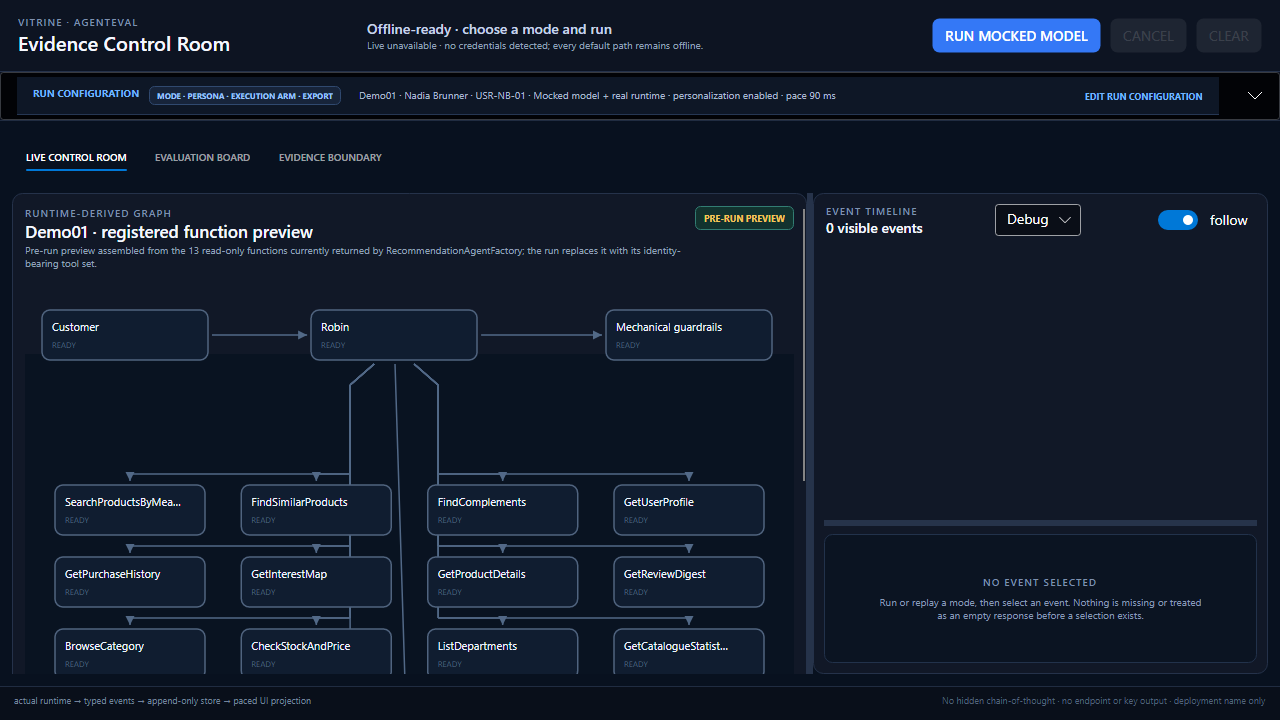
Demo01's graph and agent consume the same prepared observed tools. Demo02's topology comes from MAFWorkflowAdapter. Arrowed edges show traversal counts; nodes show execution counts; the flat BACK route and an executor-action shelf explain the loop without inventing tools.
Model/tool cards correlate by operation ID and expand to safe arguments/results or explicit absence copy. The exact screened customer response stays separate. Subject, check, and trial terminals close their starts; live session completion also closes persistence and session starts. Nothing stays ACTIVE after completion, even while optional presentation pacing drains.
For the offline suite, the board separates five mandatory evaluation gates, one matched-quality diagnostic, the persisted three-arm/two-repetition benchmark, and 43 mutation diagnostics. Eval 01–03 show every-trial acceptance with no scenario-decision rows; Eval 04/05 add per-scenario whole-trial Wilson decisions. All five show scenario trials, bounded response/trace evidence, per-check Wilson facts, comparisons, usage when reported, and local persistence. Eval 06 shows its redacted Robin safety census, safe session-level cause, per-probe allow-listed diagnostics, and 104-call ceiling. Schema-v10 JSON/HTML and replay preserve the same facts and execute nothing; integrity-valid schema-v7/v8/v9 artifacts remain readable.
Delayed hover help explains modes, personalization, JSON, HTML, replay, and disabled prerequisites. On/right means personalization enabled; actions become available only when their prerequisites exist.
Trust boundary: execution publishes immediately; optional audience pacing delays only presentation. Keys and endpoint URLs are excluded before event storage, serialization, and integrity hashing. Missing is rendered as an em dash and NOT MEASURED, never zero.
Workspace: the completed Gatekeeper-style run selector is full-width and collapsible. Mode, persona, execution arm, and export actions stay together; the panel collapses while running so the graph and event timeline dominate the view.
Evaluation modes:
OfflineSuite is the no-provider default plan; its provenance is the offline-only
OfflineDeterministic profile. Eval 01–06 are named, paid, confirmation- and
configuration-gated plans that never substitute the offline suite.
The catalogue integrity self-test expects exit 1 because detecting the planted missing SKU
is its success condition.
Follow the task-oriented operator walkthrough → · Read the implemented control-room architecture →
Avalonia control room · offline default .\start.ps1 -Mode App Demo 01 · deterministic baseline .\start.ps1 -Mode Demo01 Demo 02 · five-node MAF graph with visible route events .\start.ps1 -Mode Demo02 -NoRestore Standalone selector 1 · selectors 1–6 remain offline by default dotnet run --project src/AgentEval.VitrineDemo -- 1 Reproduce the checked-in Demo01 agent receipt · local deterministic ChatClient dotnet run --project src/AgentEval.VitrineDemo -- 1 --scripted --report docs/reports/demo01-scripted.html Provider-backed subject · both flags are required dotnet run --project src/AgentEval.VitrineDemo -- 1 --live --confirm-paid Full offline AgentEval chain .\start.ps1 -Mode Evals -NoRestore All 11 admitted checks; every healthy fixture green and ablation red dotnet run --project src/AgentEval.VitrineDemo.Evals -c Release -- --self-test Explicit paid agent use-case eval (requires secure configuration and confirmation) dotnet run --project src/AgentEval.VitrineDemo.Evals -- --eval-plan eval01-agent --scenario nadia-cross-category --confirm-paid Repeated paid workflow reliability eval dotnet run --project src/AgentEval.VitrineDemo.Evals -- --eval-plan eval05-stochastic-workflow --scenario all --repetitions 5 --confirm-paid Fixed paid Robin safety campaign; no scenario or repetition option dotnet run --project src/AgentEval.VitrineDemo.Evals -- --eval-plan eval06-safety-probes --confirm-paid Catalogue integrity self-test; expected defect detection exits 1 .\start.ps1 -Mode Ablation -NoRestore
Advanced diagnostic shortcut:
.\start.ps1 -Mode Controls -NoRestore reruns only the 43 registered control
mutations already included in the full offline AgentEval chain above. The
operator walkthrough documents this focused lane.
Standalone cost guard: credentials alone never
select a live subject. Demo01's --scripted arm drives the real agent and tools
with a local deterministic chat client; --offline, --scripted, and
--live are mutually exclusive. Provider-backed subjects require
--live --confirm-paid. --real-vectors and
--rebuild-embeddings can call an embedding provider and therefore also require
--confirm-paid.
Before the first provider call, follow the Microsoft Foundry live-run setup for the current explicit API-key/local-Entra/managed-identity contract, separate subject/judge deployment names, safe PowerShell variables, a one-case CLI/UI smoke, and sanitized evidence handling.
Agent, workflow, evals, self-test, statuses, evidence, and replay
Committed offline examples:
Demo01 HTML ·
evaluation HTML ·
evaluation JSON. Generated examples carry their
own run identity and are not the normative evaluation contract. Standard AgentEval output is also persisted below the
gitignored .agenteval/Vitrine, with six directories per benchmark execution.
One current paid integration observation:
sanitized Sofia Eval02 HTML ·
JSON. The single measured
trial is bound to implementation commit 028ac51; it proves one successful
end-to-end workflow and judge observation, not reliability or production quality.